
AI Won’t Replace Your Executives — But AI-Fluent Executives Will Replace the Ones Who Resist It

A hiring playbook for Consumer and Luxury Goods leaders in 2026
In 2023, when ChatGPT was barely twelve months old, Harvard Business School professor Karim Lakhani delivered the line that has since defined the hiring conversation in every C-suite we work with:
“AI won’t replace humans — but humans with AI will replace humans without AI.”
Two and a half years later, the data has caught up to the slogan.
This is the first piece in a series we’re publishing on how executive recruitment in consumer and luxury goods needs to change in the AI era. As an executive search firm working across beauty, wines & spirits, luxury goods, fashion, travel retail, hospitality, and the broader consumer space, ACCUR has been watching this conversation evolve in real time — from “we should probably look into AI” in 2023, to “we need a Chief AI Officer” in 2024, to today’s far more interesting and far more consequential question: what do we look for in every senior hire, not just the AI specialists?
The answer matters because the cost of getting it wrong is now measurable — and the companies your competitors are losing share to are no longer keeping it a secret.
The panic doesn’t match the data
The popular narrative says AI is about to eat half the economy. The actual data — from the firms that track this for a living — tells a much more specific story.
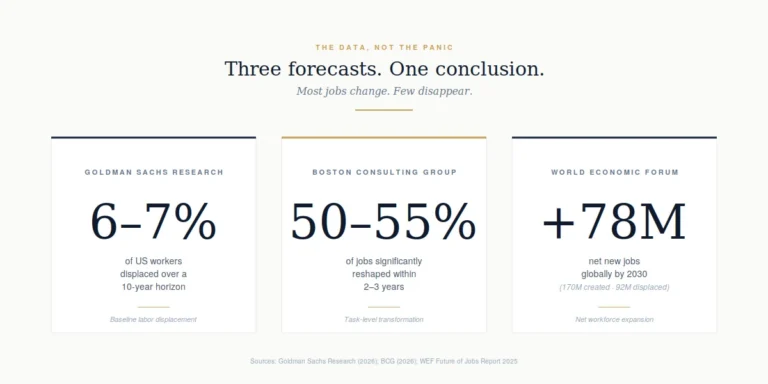
Goldman Sachs Research, which has been modeling AI’s labor-market impact since 2023, currently estimates that roughly 6 to 7% of US workers will be displaced by AI over a ten-year adoption period — meaningful, but a long way from the apocalyptic headlines. Boston Consulting Group’s 2026 forecast is sharper still: 50 to 55% of jobs will be significantly reshaped by AI within two to three years, while only 10 to 15% are projected to be fully displaced over a longer timeframe.
Read that distinction carefully. Most jobs won’t disappear. They’ll just be done differently — by people who know how to work with AI.
The World Economic Forum’s Future of Jobs Report 2025, drawing on surveys of more than 1,000 large employers, comes to the same conclusion: by 2030, 92 million jobs will be displaced and 170 million new jobs will be created — a net gain of 78 million. Nearly 40% of the skills required on the job are set to change in that same window.
The way the luxury industry itself talks about this is instructive. At the NRF Big Show in January 2026, Soumia Hadjali, Global SVP of Client Development and Digital at Louis Vuitton, framed LVMH’s official position on AI in a single sentence: “For us, AI will never replace creativity; it amplifies it.” That is also the right way to think about AI and executive talent. AI won’t replace the CEO, the VP of Marketing, or the VP of Sales. It will amplify the good ones and quietly expose the rest.
The bifurcation is already here
The most revealing data point in the entire 2025–2026 research cycle comes from Deloitte’s State of AI in the Enterprise 2026 survey, which polled 3,235 senior leaders across 24 countries and six industries, including consumer:
- 34% of organizations are using AI to deeply transform — creating new products, reinventing core processes, rethinking the business model.
- 30% are redesigning key processes around AI.
- 37% are using AI at a surface level, with little or no change to existing processes.
That last third is where the trouble lives. These companies have ChatGPT licenses, a few enthusiastic mid-level adopters, and a CEO who can say the word “AI” in a board meeting without flinching. But operationally, nothing has changed. In eighteen months, when their direct competitors are running 30% leaner on overhead and 15% faster on new product development, they will look around and wonder where the gap came from.
The gap will come from leadership. Not from technology.
Why leadership — not workforce — is the bottleneck
This is the most important finding in McKinsey’s 2025 Superagency report, and it has direct implications for how companies should hire. McKinsey surveyed 3,613 employees and 238 C-level executives and concluded, plainly, that employees are ready for AI — the biggest barrier to success is leadership.
The kicker: C-suite leaders in the same survey were more than twice as likely to blame employee readiness as they were to blame their own role. The data does not support that view. The workforce is using AI. The workforce wants more AI. It’s the executives above them who are slow-walking the transformation — and who are most likely to confuse “I’ve used ChatGPT to draft an email” with genuine AI fluency.
This is why hiring criteria need to change. Not because the next generation of CEOs needs to write Python — that was never the point — but because the current generation of CEOs, GMs, VPs, and Directors is largely being selected on credentials that no longer correlate with success.
McKinsey’s State of AI 2025 survey found that 72% of organizations have now deployed generative AI in at least one business function, and nearly 30% of organizations report that their CEO is directly responsible for AI governance — double the figure from a year earlier. CEO-level engagement is strongly correlated with reported business value from AI.
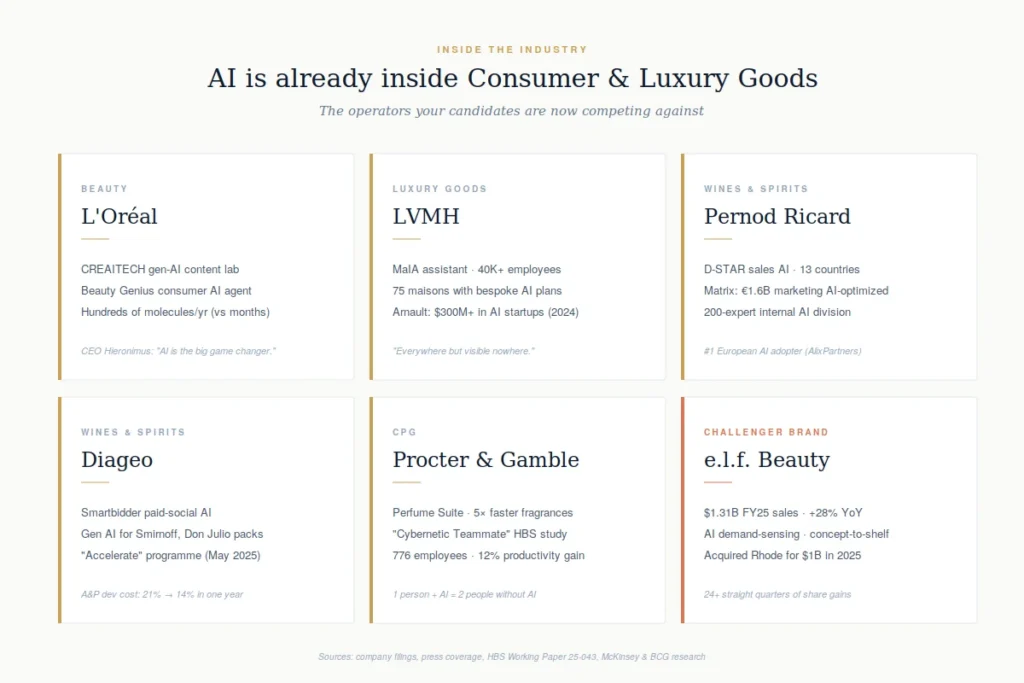
L’Oréal CEO Nicolas Hieronimus, whose company sits squarely in our top recruitment vertical, has been about as direct as a CEO can be on this point. In interviews across 2025 — and in L’Oréal’s most recent annual report — Hieronimus has said simply: “AI is the big game changer.” And: “Tech and AI are increasingly turbocharging everything we do.” L’Oréal is investing over €1.3 billion a year in research and even more in technology; its AI now scans hundreds of new molecules per year, where in the past it took months to evaluate just one.
This is what CEO-led AI looks like in practice. The firms where the CEO drives it are the firms making money on it. The firms where the CEO delegates it to IT are the firms reporting unclear ROI quarter after quarter.
If you’re hiring a CEO, GM, or VP today and AI fluency is not a top-three selection criterion, you are recruiting for the 2019 economy.
What AI-fluent executives actually do differently
This is the question we’re asked most often by clients in luxury, beauty, and CPG: what does “AI-fluent” actually mean at the executive level? It’s not Python. It’s not prompt engineering certifications. It’s a specific set of behaviors that show up — or don’t — in the way a leader operates.
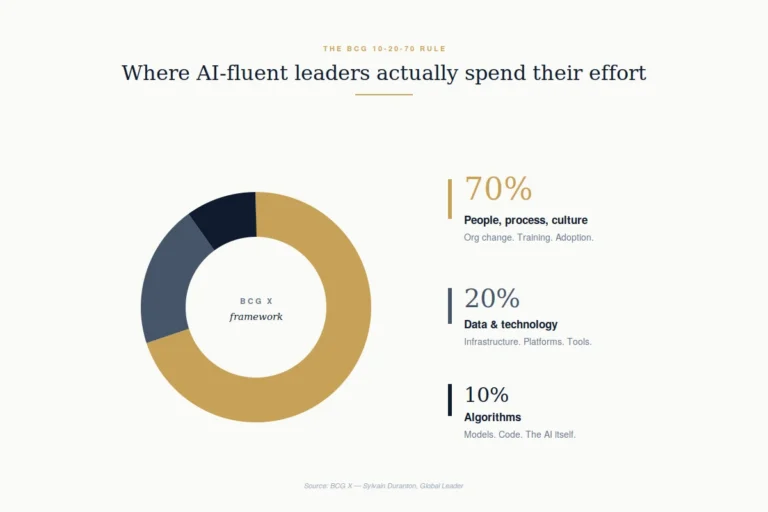
The most useful framework available comes from BCG. Sylvain Duranton, who leads BCG X globally, calls it the 10-20-70 rule: successful AI leaders allocate 70% of their effort to transforming people, processes, and culture; 20% to data and technology; and just 10% to algorithms. The implication for hiring is that the executives who will create AI value are organizational change leaders first, technologists a distant third.
The cleanest experimental evidence we have on what AI-augmented work actually produces comes from a recent study you can put directly in front of any consumer-goods board. In 2024 and 2025, researchers from Harvard Business School, Wharton, and ESSEC — including Karim Lakhani and Wharton’s Ethan Mollick — ran a pre-registered field experiment with 776 professionals at Procter & Gamble. P&G people worked on real product-innovation challenges, randomly assigned to work either with or without AI, and either alone or in two-person teams. The findings, published as the Cybernetic Teammate study in March 2025, are striking:
- Individuals using AI matched the performance of two-person teams without AI. One person plus a model performed at the level of two people without one.
- AI broke down functional silos. Without AI, R&D people produced technical ideas and commercial people produced market-oriented ones; with AI, both groups produced balanced proposals.
- Less-experienced employees benefited the most, narrowing the gap with senior talent.
This is the future of how every team in consumer and luxury goods will be staffed and structured. And the executives who already think this way — who can describe how they have personally redesigned a workflow around AI, what they handed off to the model, what they kept, and how they measured the result — are the executives who will run those teams successfully.
When we assess a candidate’s AI fluency in an executive interview, this is what we listen for. Not “yes, I use ChatGPT.” But: walk me through the last workflow you personally redesigned around an AI tool. What did you give to the AI? What did you keep for yourself? How did you measure the result?
The candidates who answer that question fluently are operating from a different paradigm than the ones who don’t. And here is the data point that should worry every hiring manager: BCG’s 2025 AI at Work study, which surveyed 10,635 employees across eleven countries, found that regular AI use among managers rose 14 points to 78% in 2025 — making managers the heaviest AI users in the workforce, ahead of frontline workers (51%) and, in many cases, ahead of the executives above them. If you hire a senior leader who is less fluent with AI than the manager reporting to them, you create an authority gap that will quietly erode credibility from below.
Why this matters more in Consumer and Luxury Goods
Consumer and luxury goods are uniquely exposed to AI on both sides of the P&L. McKinsey’s most recent research on the consumer enterprise found that CPG and retail companies leading in digital and AI are delivering three times greater total shareholder returns than their peers. Three times. That is, by itself, the entire performance gap that will define this industry’s next decade. And the brands we recruit for — beauty, wines & spirits, luxury, watches & jewelry, fashion, travel retail, hospitality — are already moving.
In luxury goods, AI is already inside the maisons
LVMH provides the clearest picture of what serious AI adoption looks like in a luxury group. Across its 75 maisons — Louis Vuitton, Dior, Tiffany, Sephora, Moët, Hennessy, Bvlgari, Celine, Dom Pérignon — LVMH has built MaIA, an internal AI assistant powered by Google Gemini, Imagen, and OpenAI’s GPT models. More than 40,000 LVMH employees now use it. Bernard Arnault himself put more than $300 million into AI startups in 2024 through his family office Aglaé Ventures. Stéphane de Pirey, who leads LVMH’s tech and digital strategy, summed up the operating principle in a way every luxury executive should memorize: “For technology to be successful in the luxury sector, it needs to be everywhere but be visible nowhere.” Every maison runs its own AI transformation plan. The Group provides the platform; the brands keep their DNA.
That is the standard. If a luxury executive cannot describe what their own brand’s equivalent looks like — what AI is operating behind their client experience, not over it — they are behind LVMH. Which is the same as saying: behind the market.
In beauty, the CEO-led model is the model
L’Oréal under Nicolas Hieronimus is now widely cited as the textbook case of an “AI-first” consumer company. Its CREAITECH generative-AI content lab, built with Google’s Imagen, Gemini, and Nvidia tools, produces ad concepts, 3D product renderings, and visuals at a speed traditional creative production cannot match. L’Oréal Paris Beauty Genius — an AI agent — delivers personalized diagnostics and advice to consumers. Inside R&D, AI now allows the company to evaluate hundreds of new molecules per year, replacing a process that previously took months to test a single one. L’Oréal owns roughly 16 petabytes of proprietary beauty data fueling all of it. The result: Hieronimus has publicly committed to increasing the weight of new product launches by 300 basis points, a target he attributes directly to AI-augmented innovation.
In wines & spirits, the leaders are pulling ahead
Pernod Ricard was named by AlixPartners as the most advanced European company in AI adoption in 2025. It runs a 200-expert internal AI division and has deployed a suite of proprietary tools: D-STAR, a sales-rep AI rolled out across 13 countries that recommends which stores to visit, which SKUs to push, and when to promote; Matrix, which reallocates the company’s roughly €1.6 billion annual marketing budget in real time; Maestria 2.0, a predictive brand-matching tool; and Genie, a generative AI content engine in pilot. Harvard Business School has now published a case study on Pernod Ricard’s employee-adoption playbook — including the early resistance from French marketers and German sales reps that the company had to overcome.
Diageo is moving on a parallel track. In its FY2025 reporting, the company disclosed that it had reduced its development costs (non-working A&P) to 14% of spend, down from 21% the prior year, by leveraging AI-driven content production and agile marketing pods. Diageo’s Accelerate programme, launched in May 2025, is built around AI-enabled efficiency. Both companies are using AI to make their VP Sales, VP Trade Marketing, and CMO roles measurably more productive — which means every other wines & spirits brand is now competing for talent against operators trained inside these environments.
If you are hiring a VP of Sales, VP of Marketing, or General Manager for a wines & spirits brand and the candidate cannot explain how AI has changed sales-rep targeting, marketing-mix modeling, or content production, they may be calibrated to a market that no longer exists.
In CPG, the bar is being set by the biggest names
The largest consumer-goods companies in the world — Nestlé, Mondelēz, PepsiCo, Unilever, Coca-Cola, and of course Procter & Gamble — are now all scaling generative and agentic AI across marketing, supply chain, and product innovation. Nestlé has built digital twins of its products in partnership with Accenture, Nvidia, and Microsoft so creative teams can adapt packaging and imagery to local markets without reshooting. Mondelēz, the maker of Oreo and Cadbury, has named AWS its strategic cloud partner and is running an end-to-end digital transformation focused on personalized consumer engagement and revenue-management AI.
And the Cybernetic Teammate study above wasn’t theoretical: it was conducted inside Procter & Gamble, with P&G’s own teams, on P&G’s own product-innovation challenges. In a separate program, P&G’s Perfume Development Digital Suite now creates new fragrances five times faster than traditional methods. If a CPG executive candidate has not internalized what this means for innovation cycles — and for the kind of team they would build — they are not ready for a senior role in the industry.
The challengers are AI-native, and they are eating share
The other reason this matters now is that the fast-growing brands disrupting your incumbents are largely AI-native by default. e.l.f. Beauty reached $1.31 billion in FY2025 sales (+28% year-over-year) with 24+ consecutive quarters of market share gains, an AI-driven demand-sensing stack that compresses concept-to-shelf timelines to months instead of years, virtual try-on, and a data clean-room infrastructure that lets it personalize across every digital touchpoint. In 2025 e.l.f. acquired Rhode — the fastest-growing US DTC beauty brand of the first half of 2025, per Consumer Edge — for $1 billion.
In beverages, the past twelve months have produced five unicorns: OLIPOP ($1.85B valuation), Poppi (acquired by PepsiCo for $1.95B), Liquid Death ($1.4B), Alani Nu, and Ghost Energy. These are companies that hit $1B in record time on the back of data, social, and algorithmic demand creation — categories where their incumbent competitors have decades of head start, vastly larger marketing budgets, and slower decision-making.
This is the strategic question every board, CEO, and PE sponsor in consumer goods now faces: are we recruiting executives who can compete with operators trained inside L’Oréal, LVMH, Pernod Ricard, Diageo, P&G, and e.l.f. — or are we recruiting executives whose mental model of the industry was set before any of this existed?
What this means for executive selection
Over the next several weeks, ACCUR will be publishing role-by-role and industry-by-industry deep dives on how to recruit AI-fluent executives in consumer and luxury goods. We’ll cover the CEO, the VP of Sales, the VP of Marketing, the VP of eCommerce, and the Director tier — and we’ll go deep on beauty, wines and spirits, and luxury goods specifically. Each piece will include the interview questions, behavioral signals, and red flags we use in our own search work.
The core principle running through all of it is simple.
The executive talent market is bifurcating. On one side are the leaders who treat AI as a strategic operating system — who have personally redesigned workflows, who can quantify AI-driven productivity in their teams, who recruit and coach around AI fluency, and who know when not to use AI (which in luxury, is often). On the other side are the leaders who still treat AI as someone else’s problem.
In 2026, hiring from the wrong side of that line is the most expensive mistake a board, a PE sponsor, or a CEO can make.
Lakhani’s line was right in 2023. It is even more right today. AI will not replace your executives. But the executives who use it well — the ones already running teams inside L’Oréal, LVMH, Pernod Ricard, Diageo, P&G, and the fastest-growing challenger brands — will replace the ones who don’t. And the companies that hire well for this transition will replace the ones that don’t.
If you’re navigating an executive hire in the consumer or luxury goods space and want to talk through how to assess AI fluency at the C-suite or VP level, get in touch with our team — or explore the industries we serve to see how we approach senior recruitment in the AI era.
Sources cited
Academic and consulting research
- Lakhani, K. — Harvard Business Publishing, AI-First Leadership: Embracing the Future of Work (2025)
- Dell’Acqua, F., Ayoubi, C., Lifshitz, H., Sadun, R., Mollick, E. et al. — The Cybernetic Teammate: A Field Experiment on Generative AI Reshaping Teamwork and Expertise, HBS Working Paper 25-043 (March 2025)
- Boston Consulting Group, AI Will Transform Over Half of Jobs Within Three Years (2026)
- Boston Consulting Group, AI at Work 2025
- BCG X, 10-20-70 Framework for AI Transformation (Sylvain Duranton)
- Goldman Sachs Research, How Will AI Affect the US Labor Market? (2026)
- Goldman Sachs Research, The Jobs AI Is Likely to Boost — and Those It May Disrupt (2026)
- World Economic Forum, Future of Jobs Report 2025
- Deloitte AI Institute, State of AI in the Enterprise 2026
- McKinsey & Company, Superagency in the Workplace: Empowering People to Unlock AI’s Full Potential (January 2025)
- McKinsey & Company, The State of AI in 2025: Agents, Innovation, and Transformation
- McKinsey & Company, From Blueprint to Breakthrough: How AI and Automation Can Transform the Consumer Enterprise (June 2025)
- McKinsey & Company, The State of Luxury 2025
- McKinsey & Business of Fashion, The State of Fashion 2026: When the Rules Change
- BCG, Why the Luxury Experience Needs an AI Moment (June 2025)
- Harvard Business School, How Pernod Ricard Stirred Up Employee Enthusiasm for AI (Working Knowledge, November 2025)
Company sources and press
- L’Oréal Annual Report 2025 (Hieronimus interview); WWD (Nov 2025); Fortune (June 2025); IMD case (2025); Glossy (2025)
- LVMH / Louis Vuitton — NRF Big Show 2026 (Retail TouchPoints); Google Cloud, Inside LVMH’s data estate (June 2025); World Luxury Chamber (2025)
- Procter & Gamble — MIT Sloan Management Review (2025); Consumer Goods Technology (April 2025)
- Pernod Ricard — CIO Magazine (October 2025); ClickZ (December 2025); Pernod Ricard Annual Report FY24
- Diageo PLC — Form 6-K, FY2025 (SEC filing); Accelerate programme announcement (May 2025)
- Nestlé / Mondelēz / Coca-Cola / PepsiCo — PYMNTS (July 2025), Global CPG Companies Join Generative and Agentic AI Rush
- e.l.f. Beauty — Consumer Goods Technology (January 2025); FY2025 investor disclosures; Beauty Independent (June 2025)
- Beverage unicorn cohort (OLIPOP, Poppi, Liquid Death, Alani Nu, Ghost Energy) — Propeller Industries (November 2025)