

Executive Compensation Benchmarking in Real Time: What Should You Pay a VP or Director?

Almost every executive search we take on begins the same way. Before the job description is final, before the target list exists, before a single candidate has been approached, the client asks a version of the same question: “What should we pay for this role — and is the number we have in mind competitive?”
It comes from CEOs, from founders and owners, and from Heads of HR who have already done their homework. Sometimes it arrives as a fully formed range with a request for a second opinion. Sometimes it arrives as a shrug: “It depends on what the person brings.” Either way, in our experience, executive compensation benchmarking has quietly become one of the most valuable things a retained search partner does for a client, and it usually happens in the first thirty minutes of the first call.
This article is about why that question is harder than it looks, why published salary surveys only take you part of the way, and what live search data actually shows for director- and VP-level roles in consumer goods right now. We have drawn the numbers below from three recent search intake conversations across home goods, watches and jewelry, and fashion and apparel, anonymized so that no company or individual can be identified, but with the real figures intact.
Why “what should we pay?” is the first real question in an executive search
Compensation is the one variable in a search that touches everything else. Set the range too low and the strongest candidates never enter the process, because a search partner cannot ethically approach a sitting VP with a number that represents a pay cut. Set it too high and you have either overpaid for the role or, more subtly, attracted candidates whose expectations the organization cannot sustain over time. Set it ambiguously and you will spend the first six weeks of the search discovering what the real range is through a sequence of awkward candidate conversations.
Senior hiring leaders know this. What has changed in the last few years is the pace at which the answer moves. The Mercer 2026 US Compensation Planning Survey found that US employers are budgeting roughly 3.5 percent for total salary increases in 2026, essentially flat with the prior year. That figure is a useful anchor for managing an existing workforce. It tells you almost nothing about what it will take to hire an external VP of Sales into a newly created role next quarter, because a new hire is priced against the external market for that specific skill set, not against your internal merit budget. The same Mercer study noted that a large majority of employers spread their increase budgets evenly across the organization rather than concentrating them on critical talent, which is one more reason the internal pay structure and the external hiring market tend to drift apart.
That drift is exactly where a search partner earns its place in the conversation. We are not working from an aggregated snapshot compiled months ago. We are working from offers accepted and declined in the last few weeks, from salary expectations collected during live candidate interviews, and from the pattern of who says yes to a first approach at a given number and who politely declines.
Why executive compensation benchmarking is harder than it looks
Most of the clients we work with come to the intake call with good data. They have consulted a salary survey, looked at comparable postings, or talked to peers. The challenge is not a lack of information. It is that three specific features of executive pay make general information difficult to apply to a specific hire.
Survey data describes a market that has already moved
Published compensation surveys are indispensable for building a pay structure. They are less reliable for pricing a single senior hire, and SHRM’s own guidance on using survey data to set executive pay is candid about why. Survey percentiles are aggregates: the executive earning the reported median base salary is often not the same executive earning the reported median total cash, so the “median” package may not describe any real person. Job matching is imperfect at the top of the org chart, where titles are inconsistent and a “VP” at one company carries the scope of a “Senior Director” at another. And the data is, by construction, a lagging indicator. SHRM suggests treating survey benchmarks as a starting point and applying a competitive band of roughly plus or minus 15 percent around them, which is a sensible framing but also an acknowledgment that the survey alone will not give you the number.
Live search activity does something different. When we have three candidates in process for a director-level eCommerce role in New York, and all three have told us their current base and their expectation, we are looking at the actual clearing price of that talent this month. That is not a substitute for a compensation philosophy. It is a highly current data point that a published survey structurally cannot provide.
Titles don’t travel: the director-versus-VP problem
Across ACCUR’s searches in consumer goods and luxury, one distinction comes up in nearly every compensation conversation: the gap between what a role is called and what the role is asked to do. A “Director” who is expected to build a function from nothing, own a strategy, and represent the company externally is doing VP work, and the market will price the role as VP work regardless of the title on the offer letter. Conversely, a “VP” title attached to a well-defined execution role inside an existing structure will not, on its own, pull the salary expectation up.
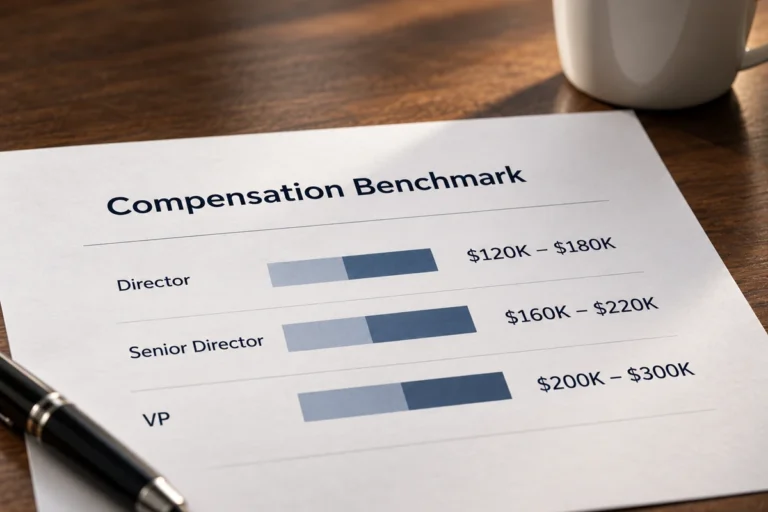
In the consumer goods searches we run, director-level base compensation most often lands between roughly $150,000 and $200,000, and VP-level base most often lands between roughly $200,000 and $275,000. Those bands overlap at the edges, and they move with geography and function, but they are a reliable first filter: if the number a client has in mind sits in the VP band, the market will expect a VP-scale mandate to go with it, and a VP-scale candidate will expect a title that reflects it.
The range is a strategy, not a number
Pay transparency has changed how candidates read a range. SHRM’s research on pay transparency found that about 70 percent of organizations posting pay ranges saw more applicants, and roughly two-thirds reported higher applicant quality. At the executive level the dynamic is similar even when nothing is posted publicly: the range you give your search partner is the range that gets communicated, in one form or another, to every candidate approached.
Width matters too. A February 2026 Harvard Business Review analysis of nearly ten million job postings found that very wide salary ranges deter a meaningful share of qualified candidates, particularly women, who read a wide range as a signal of uncertainty about the role and subsequently negotiate less aggressively. The researchers’ recommendation was to treat a range as a strategic signal rather than a compliance exercise, and to pair it with a short explanation of how offers are actually determined. In our experience the same logic applies to executive searches: a well-reasoned range communicates that the company knows what it is hiring for.

What live search data looks like: three recent examples
The most useful way to show how real-time benchmarking works is to walk through the compensation conversation from three actual search intakes. The companies and individuals have been anonymized, but the figures are the figures that were discussed.
A home goods company creating a first-of-its-kind commercial role
A home goods company came to us with a new director-level role that would be the first of its kind in the organization: the person hired would be building a partnerships strategy from the ground up rather than stepping into an existing playbook. The client had done the internal work and arrived with a proposed range of $200,000 to $230,000 base plus a 30 percent bonus target. The question was direct: does that sound low, or does it sound competitive?
For a director-level role, it is a strong number; it sits at the top of the director band and well into VP territory. What we added was a piece of market context: because this was a first hire asked to build a strategy rather than execute one, the market would read the mandate as a VP mandate, and the strongest candidates for it would be people currently carrying or about to carry a VP title. A VP title on the role would make the proposition noticeably more compelling to that pool at essentially no additional cost.
The client’s internal structure made a VP title difficult. That is a completely legitimate constraint, and a Senior Director title was floated as a workable middle path. Our view, which we shared plainly, is that compensation matters more than title in almost every case, and the range on the table was already attractive. The agreed approach was to present candidates deliberately across the range, some closer to $180,000 and some closer to $220,000, so the hiring team could see concretely what each level of investment buys in terms of experience and readiness, and revisit the target if the market pushed back. That is real-time benchmarking in its most practical form: the range becomes a hypothesis the search tests within weeks, not a fixed assumption revisited a year later.
A jewelry company opening new retail channels
A jewelry company supplying retailers wanted to add a VP of Sales whose mandate was explicitly growth: opening national retail accounts where the company did not yet have a foothold. The ownership team’s instinct on compensation was pragmatic and flexible (“it depends on what he or she brings to the table”), and when pressed for a working range they landed on roughly $175,000 to $200,000.
Our contribution was calibration rather than correction. In our recent sales leadership searches, a VP of Sales carrying an account-opening mandate at national retailers is almost always at $200,000 base or above, so $200,000 was the conservative end of the market for that role rather than the top, and $175,000 would narrow the pool. The client was open to paying for expertise, and framing $200,000 as the floor rather than the ceiling let the search target the right candidates from day one.
The same conversation covered a second role, a director-level eCommerce lead based in New York City, and here two members of the ownership team had different numbers in mind: one was thinking $150,000 to $175,000, the other closer to $125,000, reasoning that the role was more operational than revenue-generating. Both instincts were reasonable. What live search data added was two things. First, in our experience a director-level role in New York City starts at roughly $150,000 almost automatically; the geography sets a floor. Second, eCommerce compensation has followed a distinctive curve since 2020: demand surged after COVID and pushed eCommerce salaries up faster than almost any other function, but the talent pool has since grown considerably, so the premium is less extreme today than it was in 2021 and 2022. The practical conclusion was to plan for a landing point close to $150,000, understanding $125,000 as the very low end and $150,000 to $175,000 as the realistic range for the caliber of candidate the role needed.
Both were working from sound instincts and defensible views, and current market activity gave them a shared reference point to settle on.
A privately held apparel company hiring its head of finance
A privately held apparel company selling to major department stores and mass retailers, with revenue in the neighborhood of $50 million, was hiring a Controller who would in practice serve as the company’s head of finance. The ownership had a clear specification: preferably a CPA or an MBA with meaningful controller experience selling into the same kinds of retail accounts, someone who would go beyond accounting to improve processes across departments and act as a business partner to the general manager.
On compensation, the owner arrived with a well-developed view: a base range of $220,000 to $285,000 depending on experience and dynamism, with the possibility of going somewhat higher for an exceptional candidate, plus a discretionary executive bonus tied to company profitability and individual performance. This is a good example of a client who needed validation more than data. Our finance searches in consumer goods put a head-of-finance role at a company of that size squarely in that range, and it aligned closely with our overall average placement base of $200,000 to $250,000. Confirming that the range was market-correct meant the search could move immediately to the harder question of candidate fit rather than spending weeks recalibrating pay.
Two structural details from that conversation are worth passing along, because they come up constantly. First, the base range and the bonus were discussed separately and explicitly, which made the total package easy for candidates to evaluate. Second, the owner was clear about which elements were fixed (for example, in-office presence) and which were flexible (the top of the range for the right person). Candidates respond well to that clarity; a great deal of negotiation friction at the executive level comes from ambiguity about what is negotiable.
Six things we’ve learned about setting an executive salary range
Across many years of these conversations, a handful of principles hold up regardless of industry or function. They are offered here as practical calibration for leaders who already have a number in mind and want to pressure-test it.
- Price the mandate, not the title. Decide what the role is actually being asked to do — build or run, own a strategy or execute one — and let that determine the band. If the mandate is VP-scale, the compensation will need to be VP-scale whatever the title says, and the reverse is also true.
- Compensation matters more than title, but title is a free lever. A Senior Director or VP title costs nothing and can meaningfully widen the pool of candidates willing to take a first call. Where reporting lines make a VP title impossible, a Senior Director title with a VP-level range is a proven middle path.
- Anchor the floor in the market, not the ceiling in the budget. The most useful question is not “what is the most we would pay?” but “what is the lowest number at which the right candidates will still say yes to a conversation?” In our recent searches, that floor has been roughly $200,000 for a VP of Sales with a growth mandate and roughly $150,000 for a director-level role in New York City.
- Ask to see candidates across the range. A good search partner can deliberately present a spread — some candidates near the bottom of the band, some near the top — so that the hiring team can see, with real people, what each increment of investment buys. This turns an abstract range into a concrete decision.
- Treat the number as a hypothesis with a short feedback loop. The first two to three weeks of outreach will tell you how the market is reading your range: response rates to a first approach, the stated expectations of the people who reply, and who declines. Build in a checkpoint to revisit the range with that evidence rather than waiting for a failed offer.
- Separate base, bonus, and structure explicitly. State the base range, the bonus target or mechanism, and any non-negotiables (in-office expectations, location) clearly and separately. Candidates evaluate the whole package, and the clearer each component is, the less negotiation friction you will encounter at the offer stage.
WTW — a global advisory, broking, and benefits consulting firm whose annual compensation outlook is widely used across HR and finance — makes a related point at the portfolio level in its 2026 predictions: with salary budgets stabilizing in the low single digits, the firm expects organizations to concentrate pay adjustments and variable compensation on strategic, hard-to-fill roles rather than spreading them evenly. An external executive hire into a growth mandate is precisely that kind of role. Pricing it against the internal merit budget rather than the external market is the most common way we see otherwise well-run searches lose momentum.
How to use a search partner as a compensation benchmarking resource
None of this requires a separate engagement. The benchmarking happens naturally inside a well-run retained search, and the clients who get the most from it tend to do a few things deliberately.
Bring your number, and your reasoning, to the first call
The intake conversation is more productive when the client shares both the range and the logic behind it: what internal comparators it was built on, what survey data informed it, how it relates to the rest of the leadership team’s pay. That lets a search partner add market perspective precisely where it is most useful, whether that is confirming the range (as with the head-of-finance search above), flagging a title-to-mandate mismatch (as with the home goods role), or reconciling two internal views (as with the jewelry company’s eCommerce role).
Ask for the data that lives inside the search
A retained search generates a great deal of compensation intelligence as a byproduct. In our retained executive search engagements, the weekly progress report shared with the client lists every candidate identified and approached, along with their title, employer, location, and, where we have it, their salary expectation. Read across twenty or thirty names, that report is a live compensation survey for the exact role, level, geography, and industry the client is hiring in. We encourage clients to use it that way.
Expect function and geography to move the number
The bands above are consumer goods bands, and they shift by function and place. Sales and business development roles with an account-opening mandate price at the top of their level. Digital and eCommerce roles carry a premium that has moderated since 2022 but has not disappeared. Finance roles at privately held companies are often paired with discretionary bonuses that can be substantial and should be discussed explicitly. And New York City sets a floor for director-level pay that a company hiring in a lower-cost market may not need to match. A search partner working across beauty, wines and spirits, CPG, and the other consumer verticals will see these patterns across dozens of concurrent searches, which is what makes the calibration current.

Frequently asked questions about executive compensation benchmarking
How much should you pay a VP of Sales in consumer goods?
In ACCUR’s recent searches, a VP of Sales with a genuine growth mandate, such as opening new national retail accounts, is almost always at a base of $200,000 or above, with $200,000 representing the conservative end of the market rather than the top. The number rises with the size of the accounts in play, the scarcity of relevant relationships, and geography.
What is the difference between director and VP salary?
In the consumer goods searches we run, director-level base compensation most often falls between roughly $150,000 and $200,000, and VP-level base between roughly $200,000 and $275,000. The bands overlap, and the more reliable predictor of where a specific role lands is the mandate rather than the title: a role asked to build a function or own a strategy prices as VP work regardless of what it is called.
Are salary surveys enough for executive compensation benchmarking?
Surveys are an essential starting point and the right tool for building a pay structure. For a single senior hire, their limitations are well documented: aggregated percentiles that may not describe any real package, imperfect job matching at the top of the org chart, and a built-in time lag. Pairing survey data with live market intelligence from an active search gives you both the structural view and the current clearing price.
How wide should an executive salary range be?
Wide enough to accommodate genuine differences in candidate experience, narrow enough to signal that the company knows what it is hiring for. In practice, the ranges our clients land on for director and VP roles are typically $25,000 to $65,000 wide. Pairing the range with a short explanation of what moves a candidate toward the top of it makes the range more effective, a finding that recent Harvard Business Review research supports.
How current is compensation data from an executive search firm?
It reflects offers, expectations, and responses from searches active in the last few weeks, which is why it is often more precise for a specific role than a published survey. It is narrower in scope than a survey, however, so the two are best used together.
The number is the beginning of the conversation
The clients we work with rarely arrive without a view on compensation. They arrive with a well-reasoned number and a sensible question: is this right for today’s market, for this specific mandate, in this specific place? What a specialist search partner adds is not a correction but a second, highly current source of evidence, drawn from the candidates being approached this month for roles like yours, and a process that tests the range quickly and adjusts it with real data rather than assumptions.
If you are scoping a director- or VP-level hire in consumer goods, luxury, or an adjacent industry and would value a current read on the market for that role, our retained executive search team is glad to share what we are seeing. Get in touch with ACCUR to start that conversation.
Sources
- Mercer, “Most US Employers Plan to Keep 2026 Salary Increases Flat” (Mercer 2026 US Compensation Planning Survey). Mercer is a global HR and workplace benefits consulting firm whose compensation surveys are widely used by employers to set annual pay budgets.
- WTW, “Top 5 Compensation Predictions for 2026”. WTW (formerly Willis Towers Watson) is a global advisory, broking, and solutions firm; its annual compensation outlook is a standard reference for HR and finance teams planning pay strategy.
- SHRM, “How to Use Compensation Survey Data to Set Executive Pay”. SHRM (the Society for Human Resource Management) is the world’s largest professional association for human resources practitioners.
- SHRM, “New SHRM Research Shows Pay Transparency Makes Organizations More Competitive, Leads to Increase in Qualified Applicants”.
- Harvard Business Review, “Research: Posting a Wide Salary Range Can Deter Women from Applying” (February 2026).